
Study the complete Class 9 Kaushal Vikas Chapter 3 question answers, including precision-farming layouts, protected cultivation, digital tools, sensors, irrigation, pest management, safety, and reflection.
Question Answers
Portfolio – Page 42
1Where will you use the precision techniques – in a farmer’s field or in school?
I will use the precision techniques in school by setting up a small precision farming unit or plant nursery.
This is suitable because a school provides a safe and controlled place for learning. Students can observe plants daily, collect data about temperature, humidity and soil moisture, and use techniques like drip irrigation, humidity chamber, shade-net or low-tunnel. It will also help students understand how technology can save water, reduce wastage and improve plant growth.
2Which plants will you grow? Justify your choice.
I will grow spinach, coriander, fenugreek and tomato seedlings in the school precision farming unit.
These plants are suitable because:
- They have a short life cycle and can grow within 2–3 months.
- They can be grown in small beds, trays or pots.
- Leafy vegetables like spinach and fenugreek grow quickly and are easy to observe.
- Tomato seedlings can be raised in a humidity chamber and later shifted to beds or pots.
- These plants are useful for the school or community because they can be used as food.
Thus, these plants are useful, easy to manage and suitable for learning precision farming techniques.
Question Answers
Check Your Understanding – Page 45
1Students of Government High School collected data from the school meteorological observatory and the meteorological department website. They observed that the temperature usually ranges between 22°C and 34°C (the hottest months are April and May, while December is the coolest with 22°C). The area experiences heavy monsoon rainfall, mainly from June to September (average annual precipitation of around 3,000 to 3,350 mm). Humidity remains high, between 70 and 90 per cent, especially during the monsoon season. Which crop protection method should they use? Justify your selection.
The students should use a greenhouse or shade-net structure with proper ventilation and drainage.
A greenhouse will be useful because the area receives very heavy rainfall during the monsoon. It can protect plants from excess rain and reduce damage caused by waterlogging. Since the temperature can reach 34°C in April and May, a shade-net can also be used to protect plants from high temperature and scorching heat.
A humidity chamber is not the best main protection method because the area already has high humidity, especially during monsoon. A low-tunnel is also less suitable because it mainly increases temperature, while this area does not need extra warming.
So, the best choice is:
Greenhouse for protection from heavy rainfall + shade-net for protection from high temperature.
This will help maintain better growing conditions for plants.
Question Answers
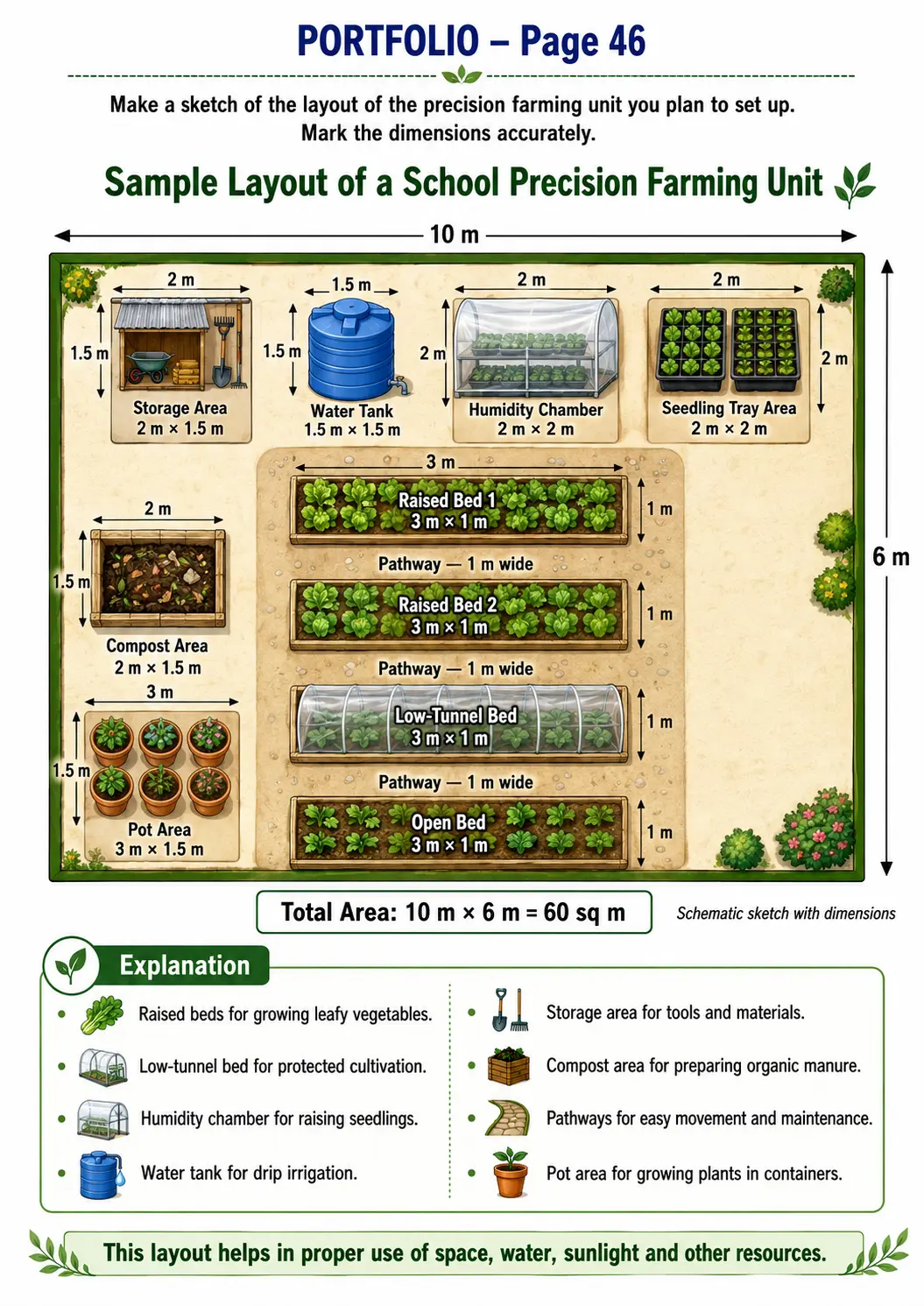
Portfolio – Page 46
1Make a sketch of the layout of the precision farming unit you plan to set up. Mark the dimensions accurately.
Question Answers
Task – Page 58
Indian Council of Agricultural Research (ICAR) has launched a mobile-based pest identification and surveillance application named National Pest Surveillance System (NPSS). It uses Artificial Intelligence (AI) and Machine Learning (ML) technology for identification of insect pests in farming. Identify the insects on the plants or those collected in the light trap using the mobile app.
1What is their role in the ecosystem?
Insects play different roles in the ecosystem. Some insects help in pollination, some act as decomposers, some are part of the food chain, and some insects are pests that damage crops.
For example, bees and butterflies help in pollination. Ants and beetles help in decomposition. Some insects are eaten by birds, frogs and lizards. However, insects like aphids, caterpillars and whiteflies may damage plants by feeding on leaves, stems or plant sap.
2What value do they add to the ecosystem?
Insects add great value to the ecosystem in the following ways:
- They help in pollination of flowers.
- They help plants produce fruits and seeds.
- They break down dead organic matter.
- They improve soil fertility.
- They act as food for birds, frogs and other animals.
- Some insects help control harmful pests naturally.
Thus, all insects should not be destroyed. Only harmful pest populations should be managed carefully.
3How many of them are pests (harmful for your plants)?
The number of pests will depend on the insects identified through the NPSS app or light trap.
For example, suppose 10 insects are identified:
| Insect | Pest or Useful |
|---|---|
| Butterfly | Useful pollinator |
| Honeybee | Useful pollinator |
| Ladybird beetle | Useful predator |
| Ant | Usually useful |
| Earth beetle | Useful decomposer |
| Aphid | Pest |
| Whitefly | Pest |
| Caterpillar | Pest |
| Grasshopper | Pest |
| Mealybug | Pest |
In this example, 5 out of 10 insects are pests.
Therefore, students should identify the insects using the app and then count how many are harmful to plants.
Question Answers
Assess Your Learning
1Describe the role of digital tools in precision farming. How do they change the way decisions are made on farms?
Digital tools play an important role in precision farming. They help farmers collect and use data for better decision-making.
Examples of digital tools include:
- Weather apps
- Soil moisture sensors
- Humidity sensors
- Temperature sensors
- Pest identification apps
- Drones and satellite images
- Market price apps
These tools help farmers decide when to irrigate, how much fertiliser to apply, when to protect crops from pests, and when to harvest. Earlier, many decisions were based only on experience or guesswork. In precision farming, decisions are based on actual data.
Thus, digital tools make farming more accurate, scientific and resource-efficient.
2Create a safety checklist for the tools you used, including digital tools.
Safety Checklist for Precision Farming Tools
| Tool / Material | Safety Precaution |
|---|---|
| Hand trowel | Do not leave it lying around; store safely after use. |
| Pruning scissors | Keep blades closed when not in use. |
| Measuring tape | Use carefully and avoid sharp metal edges. |
| Gloves | Wear while handling soil, compost or manure. |
| Spray bottle / watering can | Avoid spilling water on the floor to prevent slipping. |
| Bamboo / metal frame | Ensure frames are fixed properly and have no sharp edges. |
| Polyethylene sheet / shade-net | Tie properly so that it does not fly away in wind. |
| Hygrometer | Handle carefully and keep away from excess water. |
| Soil moisture sensor | Do not touch wires with wet hands. |
| Mobile app / digital device | Keep mobile away from water and use under teacher supervision. |
| Electric pump / sensor circuit | Use only with teacher guidance; avoid loose wires. |
3During a visit to a precision farming unit, list the key aspects you would observe to understand how precision techniques are applied.
During a visit to a precision farming unit, I would observe the following key aspects:
- Tools and materials used — I would observe tools like sensors, drip pipes, sprayers, trays and measuring tools.
- Crop protection method — I would check whether the unit uses greenhouse, shade-net, low-tunnel or humidity chamber.
- Irrigation system — I would observe whether drip irrigation or sprinklers are used.
- Use of sensors — I would check if soil moisture sensors, temperature sensors or humidity sensors are used.
- Fertiliser application — I would observe whether compost and fertilisers are applied in measured amounts.
- Pest management — I would observe how pests are identified and controlled.
- Safety protocols — I would check whether tools are stored safely and whether workers use gloves or protective equipment.
- Harvesting and packaging — I would observe how produce is harvested, labelled, packed and stored.
4A farmer is using random compost application in one nursery bed and measured compost in another.
The nursery bed with measured compost application will show better and more uniform plant growth.
In random compost application, some plants may get too much compost while others may get too little. This can cause uneven growth, wastage of compost and poor soil balance.
In measured compost application, the correct quantity of compost is added according to the requirement of the soil and plants. This helps maintain proper organic carbon, improves water-holding capacity, supports beneficial microorganisms and gives nutrients evenly to plants.
Therefore, measured compost application is better because it saves resources and supports healthy plant growth.
5You are asked to design a nursery layout. How would you ensure uniform growth and optimal use of resources?
To ensure uniform growth and optimal use of resources, I would design the nursery layout in the following way:
- I would make raised beds of equal size.
- I would keep proper spacing between plants.
- I would provide pathways for easy movement.
- I would use drip irrigation for uniform watering.
- I would place plants according to their sunlight needs.
- I would use a humidity chamber for seedlings.
- I would use shade-net or low-tunnel according to weather conditions.
- I would apply measured compost and biofertiliser.
- I would keep a water tank and storage area in proper places.
- I would monitor temperature, humidity and soil moisture regularly.
This will help all plants get equal water, nutrients, sunlight and protection.
6‘With the help of technology, you can grow anything, anywhere, anytime.’ Do you agree with this statement? Give two examples to support your answer. If a farmer has limited water resources, how can precision farming techniques help them use water more efficiently?
I partially agree with the statement. Technology can help us grow many crops in difficult conditions, but it may not always be possible to grow anything, anywhere and anytime because every plant has basic needs like suitable temperature, light, water and nutrients.
Examples
- Low-tunnel farming — Low-tunnels can help grow summer vegetables like tomato and cucumber during colder months by trapping heat and protecting plants.
- Greenhouse or shade-net farming — Greenhouses and shade-nets help protect plants from rain, frost, high temperature and harsh sunlight.
If a farmer has limited water resources, precision farming can help through:
- Drip irrigation to deliver water directly to the roots.
- Soil moisture sensors to water plants only when needed.
- Mulching to reduce evaporation.
- Valves and pipes to control water flow.
- Fertigation to provide water and nutrients together in measured amounts.
Thus, precision farming helps save water and reduce wastage.
7Suggest one low-cost innovation that could help small farmers adopt precision farming practices.
One low-cost innovation is a DIY drip irrigation system using waste plastic bottles.
In this method, small holes are made in plastic bottles and the bottles are placed near the roots of plants. Water slowly drips into the soil and reaches the root zone. This saves water and reduces wastage.
It is useful for small farmers because:
- It is inexpensive.
- It uses easily available materials.
- It saves water.
- It provides water directly to plants.
- It is simple to set up and maintain.
8Of the tasks that you did, which did you enjoy the most? Which did you enjoy the least? Give examples of what went well and what did not go well. What would you do differently next time?
I enjoyed setting up the drip irrigation system the most because it was interesting to see how water could be supplied directly to the roots of plants. It helped me understand how precision farming saves water.
The task I enjoyed the least was testing soil and measuring compost, because it required careful measurement and observation.
What went well:
- The layout was prepared properly.
- The drip pipes were arranged neatly.
- The seedlings grew well in the humidity chamber.
- Water wastage was reduced.
What did not go well:
- Some drippers got blocked.
- Some plants received less sunlight.
- The humidity chamber needed regular monitoring.
Next time, I would clean the drip system regularly, choose a better location for sunlight, and maintain a daily observation record.
9Give examples of how you can apply your learning in a real-life situation.
I can apply my learning from precision farming in real life in the following ways:
- I can grow vegetables at home using pots or grow bags.
- I can use drip irrigation to save water in a home garden.
- I can prepare compost from kitchen waste.
- I can use a shade-net to protect plants from strong sunlight.
- I can use a mobile app to identify pests.
- I can observe weather conditions before watering or harvesting plants.
- I can grow healthy seedlings using a simple humidity chamber.
- I can help farmers understand low-cost precision farming methods.
- I can avoid overuse of water, fertilisers and pesticides.
- I can use labels or QR codes to share information about harvested produce.
Thus, precision farming learning can be used in school, home gardens, nurseries and farms.
Open the separate notes / explanation page for this same chapter.
Open Notes / ExplanationReturn to the complete Kaushal Vikas chapter list.
View all chapters