
Study the complete Class 9 Kaushal Vikas Chapter 1 question answers, including weather data, soil testing and improvement, crop selection, the agricultural value chain, reflection, and real-life applications.
Question Answers
Check Your Understanding – Page 9
1Find out what kind of data farmers use in the region your school is located in. Why is this useful for them?
Farmers in our region use different kinds of weather and agricultural data, such as:
- Rainfall data – to know when to sow seeds and how much irrigation is needed.
- Temperature data – to choose suitable crops and protect crops from heat or cold.
- Humidity data – to understand moisture in the air and chances of plant diseases.
- Wind direction and wind speed – to protect crops from strong winds and soil erosion.
- Weather forecast – to plan sowing, irrigation, harvesting and spraying of pesticides.
- Soil moisture data – to decide when crops need watering.
This data is useful because farming depends greatly on climate and weather. The chapter explains that weather forecasts and advisories help farmers plan crops in kharif, rabi and summer seasons. It also explains that rainfall, temperature, humidity and wind are important for crop growth and livestock care.
Question Answers
Check Your Understanding – Page 16
1Which test did you do?
We did the mason jar test to check the percentage of sand, silt and clay in the soil. We also did the pH test to find whether the soil was acidic, neutral or alkaline.
2What were the results of the test?
In the mason jar test, we found that the soil had a high percentage of sand. This means the soil could not hold much water and nutrients.
In the pH test, we found that the soil was slightly acidic because its pH was below 6.
3What steps did you take to improve the quality of the soil?
To improve the soil quality, we added compost or garden soil because sandy soil holds very little water. Compost increases the water-holding capacity of soil and adds nutrients.
Since the soil was acidic, we added lime or dolomite to reduce acidity and make the soil more suitable for plant growth. The chapter says that if sand is more than 80 per cent, compost or garden soil should be added, and if soil pH is below 6, compost, wood ash, lime or dolomite can be added.
Question Answers
Assess Your Learning
1A farmer has sandy soil with high acidity. Suggest two amendments and explain how they will improve soil quality.
The farmer should use the following two amendments:
1. Compost or organic matter
Sandy soil holds very little water. Adding compost will improve the water-holding capacity of the soil. It will also add nutrients and organic matter, making the soil more fertile.
2. Lime or dolomite
The soil is highly acidic, so lime or dolomite should be added. It will reduce acidity and bring the soil pH closer to neutral. Most plants grow well in slightly acidic to neutral soil, around pH 6–7.
Thus, compost will improve soil texture and fertility, while lime or dolomite will correct soil acidity.
2Non-timber Forest Produce (NTFP) refers to all useful products from forests (except timber), including resin, medicinal plants, fruits, nuts, etc. Lac is an important NTFP that is produced by a tiny insect, Kerria lacca, which secretes a resinous substance as a protective coating on the branches of host trees. Lac production is dependent on insect population. Insect growth in turn depends on suitable host plants and a warm and humid climate, among other factors like growth of plant, etc. If you were part of a team building a meteorological observatory to help monitor conditions for the growth of Kerria lacca, which two instruments would you prioritise and why?
I would prioritise the following two instruments:
1. Dry-wet bulb thermometer
This instrument measures temperature and helps find humidity. Kerria lacca grows well in warm and humid conditions, so temperature and humidity are very important for its growth. If humidity is too low, it may affect the insect population and lac production.
2. Rain gauge
A rain gauge measures rainfall. Rainfall affects the growth of host plants on which Kerria lacca lives. Good plant growth provides better branches and food support for the lac insect.
So, the dry-wet bulb thermometer will help monitor warmth and humidity, while the rain gauge will help monitor rainfall needed for healthy host plants. The chapter also explains that rainfall, temperature and humidity are important meteorological parameters for agricultural practices.
3Table 1.3 shows the rainfall in a region and the rainfall requirements of some crops. On the basis of the rainfall data, suggest which among the following crops can be safely planted in the region and when. Justify your choice.
The rainfall in the region varies from 333 mm to 974 mm. Therefore, crops needing very high rainfall cannot be safely grown.
Crops that can be safely planted
1. Jowar
Rainfall requirement: 500–1000 mm
This crop is suitable because many years in the table have rainfall around or above 500 mm. It is a good choice for moderate rainfall areas.
2. Groundnut
Rainfall requirement: 500–1250 mm
Groundnut can be safely planted because the region often receives rainfall between 500 mm and 974 mm.
3. Soyabean
Rainfall requirement: 500–1000 mm
Soyabean is suitable because its rainfall requirement matches the rainfall of many years in the region.
4. Maize
Rainfall requirement: 500–1000 mm
Maize can also be planted safely in years when rainfall is around 500 mm or more.
5. Cotton
Rainfall requirement: 500–1000 mm
Cotton is also suitable because its rainfall requirement fits the rainfall pattern of the region.
Crops that are not safe choices
Rice needs 1500–3000 mm, so it is not suitable.
Jute needs 1250–2000 mm, so it is not suitable.
Sugarcane needs 750–1500 mm, so it can grow only in high-rainfall years like 2017, 2019 and 2022, but it is not a safe choice every year.
Wheat needs 750–1000 mm, so it is suitable only in some years and not safe for all years.
Pulses need 400–500 mm, so they may be suitable in low-rainfall years like 2015 and 2021.
When to plant?
Jowar, groundnut, soyabean, maize and cotton should be planted mainly in the Kharif season, because they are monsoon crops and depend on rainfall. According to the crop calendar in the chapter, Kharif crops are grown during the hot and heavy rainfall period.
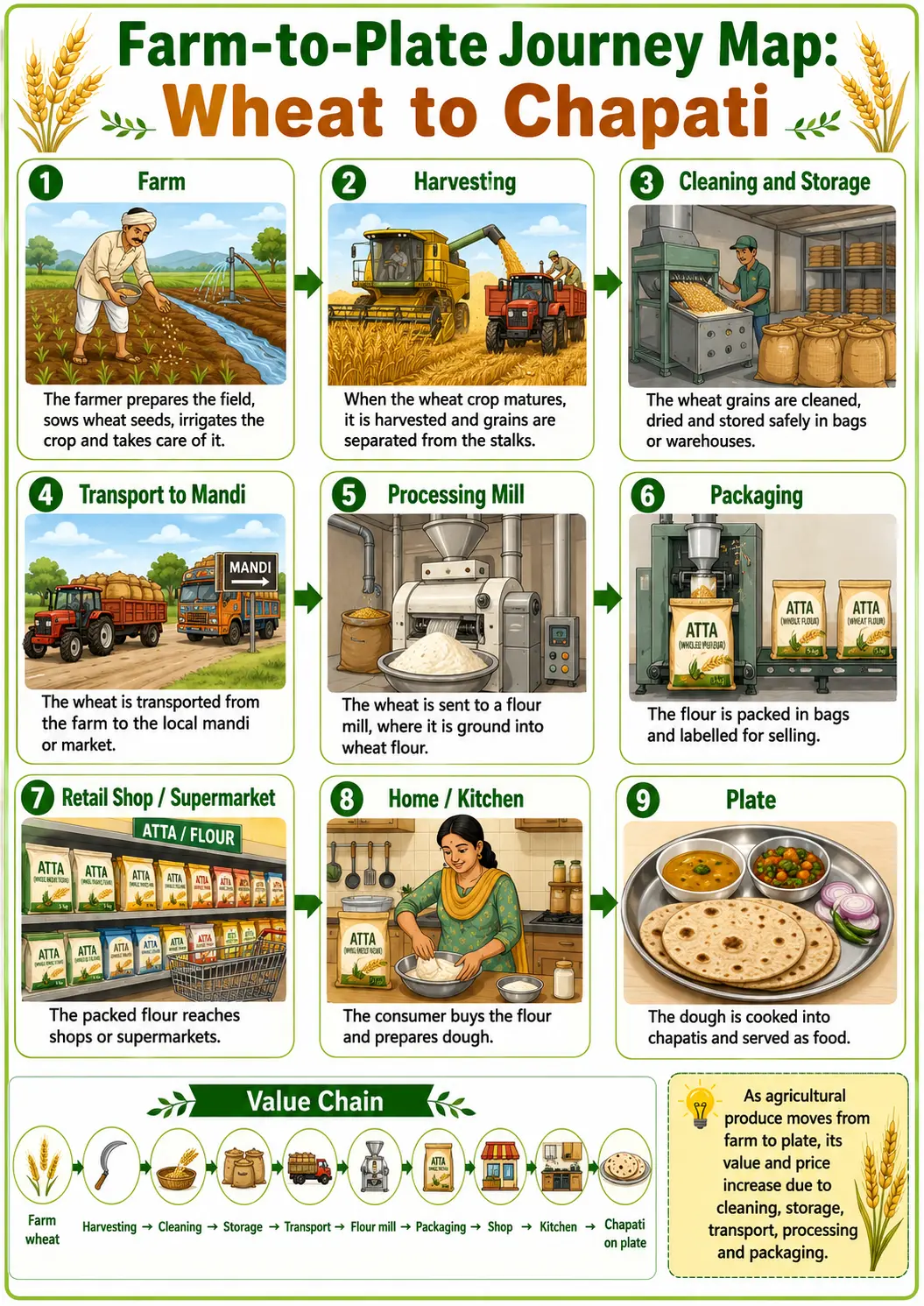
4Create a farm-to-plate journey map for any farming produce. Indicate the value chain as the produce travels from where it was grown to the table in the form of food.
Farm-to-Plate Journey Map: Wheat to Chapati
5Of the tasks that you did, which did you enjoy the most? Which did you enjoy the least? Give examples of what went well and what did not go well. What would you do differently next time?
I enjoyed the soil testing activity the most because it helped me understand the quality of soil in a practical way. I learned how soil texture and pH affect plant growth. The best part was observing the soil layers in the jar and understanding the amount of sand, silt and clay.
I enjoyed the weather observation task the least because it required regular observation and recording. Sometimes it was difficult to take readings at the same time every day.
What went well
The soil sample was collected properly, and the soil layers could be seen clearly after settling.
What did not go well
In the weather observation activity, some readings were missed because of lack of regular timing.
What I would do differently next time
Next time, I would make a proper observation table, take readings at a fixed time every day and work more carefully in a group.
6Give examples of how you can apply your learning in a real-life situation.
I can apply my learning in real life in the following ways:
1. Testing soil before planting
I can test soil texture and pH before growing plants in a garden or field.
2. Improving soil quality
If the soil is sandy, I can add compost. If it is acidic, I can add lime or dolomite.
3. Selecting healthy seeds
I can use the floating method in salt water to remove damaged or hollow seeds before sowing.
4. Using weather information
I can check rainfall, temperature and humidity before deciding when to sow or irrigate crops.
5. Making organic manure
I can use agro-waste and cow dung to make compost or vermicompost.
6. Understanding food prices
I can understand why food becomes costlier after storage, transport, processing and packaging.
Thus, this chapter helps us understand practical agricultural skills that can be used in gardening, farming and daily life.
Open the separate notes / explanation page for this same chapter.
Open Notes / ExplanationReturn to the complete Kaushal Vikas chapter list.
View all chapters